Key Takeaways:
- A well-run Airbnb in Nairobi can generate 2-3x the income of a long-term rental from the same apartment — but “well-run” is doing a lot of heavy lifting in that sentence
- Long-term rentals in Nairobi yield roughly 5-6% annually. Short-term rentals can hit 8-14% — if you know what you’re doing
- Most people who switch from long-term to Airbnb underestimate the operational cost, time commitment, and skill required — then blame the platform when it doesn’t work
- The right answer depends on your tolerance for work, your property’s location, and whether you’re willing to invest in quality furnishing and professional management
Every week someone in a Nairobi property group asks the same question: “Should I Airbnb my apartment or just rent it out long-term?”
The replies are always the same. Half the group says Airbnb is a goldmine. The other half says it’s a nightmare. Both are right — they’re just talking about completely different operations.
We manage multiple short-term rental units across Westlands, Kilimani, Kileleshwa, and Lavington. We also track 800+ Nairobi Airbnb listings daily. So when we compare airbnb vs rent in Nairobi, we’re not guessing. We’re reading the spreadsheet.
Here’s the honest breakdown.
The Numbers: Airbnb vs Rent Nairobi (Real Data)
Let’s start with what everyone actually cares about — the money.
Long-Term Rental Income
A furnished 1-bedroom apartment in a decent Westlands or Kilimani building rents for KES 65,000-90,000/month on a long-term lease. A 2-bedroom goes for KES 80,000-120,000/month.
It’s straightforward. Tenant moves in, pays monthly, you handle the occasional maintenance issue. Most owners use a property management company (10-20% of rent) and an agent to find tenants (one month’s rent as a finder’s fee). Factor those in and your actual take-home is lower than the headline number — but it’s consistent and requires very little of your time.
The trade-off? Your income is capped. A 2-bed in Kilimani renting at KES 100K/month will rent at KES 100K/month next year, and the year after that. There’s no lever to pull. No peak season premium. No way to earn more without buying another property.
It’s a reliable, predictable return — and for a lot of property owners, that’s exactly what they want.
Annual gross on a 1-bed at KES 75,000/month: KES 900,000.
Short-Term Rental (Airbnb) Income
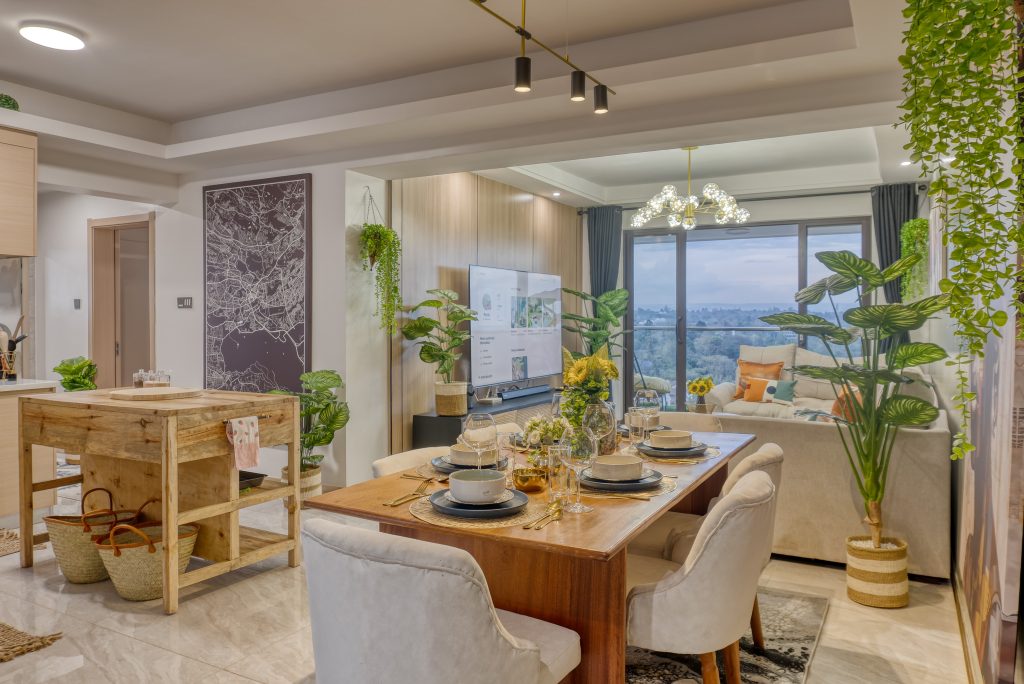
The same 1-bedroom, properly furnished and professionally photographed, listed on Airbnb at a strategic nightly rate with length-of-stay discounts:
- 1-bed nightly rate: KES 8,200-12,500
- 2-bed nightly rate: KES 12,500-17,500
- Occupancy: 70-85% (top performers)
- Monthly gross (2-bed avg): KES 280,000-395,000
- Annual gross (2-bed avg): KES 3,375,000-4,730,000
Read that again. The top end is 4x the long-term rental income from the same apartment.
But before you call your tenant and tell them to start packing — keep reading.
That 4x revenue number is gross. Here’s what eats into it:
The Costs Nobody Talks About
Long-Term Rental Costs
- Property management: 10-20% of monthly rent if you don’t self-manage
- Agent/finder’s fee: 1 month’s rent every time you need a new tenant
- Maintenance: Things break. It’s a property. Budget accordingly.
Airbnb Costs (Professionally Managed)
This is where most people’s spreadsheets fall apart. They model the revenue and forget half the costs. Let’s walk through a real example — a 2-bedroom in Westlands or Kilimani, professionally managed, at 75% occupancy with an average nightly rate of KES 15,000.
Step 1: Gross revenue
- KES 15,000/night × 30 days × 75% occupancy = KES 337,500/month gross
Step 2: Airbnb takes their cut
- Airbnb service fee = ~15% of gross
- KES 337,500 × 15% = KES 50,625
- After Airbnb: KES 286,875
Step 3: Management fee
- Professional management company takes 20% of what’s left
- KES 286,875 × 20% = KES 57,375
- After management: KES 229,500
Step 4: Operating expenses (~KES 25,000/month)
- Cleaning & laundry: ~KES 8,500
- Utilities (electric, water, WiFi): ~KES 10,000
- Guest supplies (toiletries, coffee, consumables): ~KES 6,500
Owner take-home: ~KES 204,500/month
And guess what thats at 75% occupancy which for a quality operator is a slow month.
That’s KES 2.45M annually from a professionally managed 2-bedroom. Compare that to a long-term rental at KES 100K/month minus management fees. The Airbnb is earning 3-4x more — and you’re spending less time on it.
Upfront investment: Furnishing a 2-bed to Airbnb standard costs KES 1M-1.6M for furniture alone (see our real cost breakdown). At KES 204K/month net, the furnishing pays for itself within 5-8 months.
What About Self-Managing?
Skip the 20% management fee and that KES 204K becomes ~KES 262K/month. Sounds like easy maths.
But here’s the catch: that number only holds if you maintain the same occupancy and nightly rates a professional operator achieves. Most self-managers don’t. Pricing mistakes, slow response times, inconsistent cleaning, no review strategy — occupancy drops from 75% to 50%, your nightly rate falls because your reviews slip, and suddenly you’re netting less than you would have with a manager.
Self-managing works if you treat it like a real business and learn the systems. If that’s your plan, the ESA Academy teaches you exactly how we run our portfolio — pricing, operations, guest comms, cleaning systems, the lot. Do it right or pay someone who will.
The Real Cost: Your Time

Here’s what the airbnb vs rent in Nairobi conversation always misses: the operator’s time.
Long-term rental management: ~2 hours/month. Collect rent. Handle the odd maintenance request. Done.
Airbnb management (self-managed, 1 unit):
- Guest messaging: 30-60 min/day
- Coordinating cleaners: 15-30 min per turnover
- Check-in/check-out management: 15-30 min per guest
- Pricing adjustments: 1-2 hours/week
- Maintenance coordination: 2-4 hours/week
- Restocking and quality checks: 2-3 hours/week
That’s roughly 15-25 hours/month for a single unit. If your time is worth KES 2,000/hour, you’re spending KES 30,000-50,000/month in uncosted labour. Nobody puts that in the spreadsheet.
Scale to 3 units and you have a full-time job. Scale to 5+ and you either hire help or burn out. This is why professional management exists — and why it’s worth the 20-30% fee for most people.
Don’t want the operational headache? Talk to us about full-service management — we handle everything from furnishing to guest comms to cleaning, and you collect the income.
Airbnb vs Rent Nairobi: The Side-by-Side
Here’s the honest comparison for a 2-bedroom in Westlands or Kilimani:
| Long-Term Rental | Airbnb (Self-Managed) | Airbnb (Professionally Managed) | |
|---|---|---|---|
| Monthly Gross | KES 100,000 | KES 337,500 | KES 337,500 |
| Airbnb Fee (15%) | — | -KES 50,625 | -KES 50,625 |
| Management Fee | -KES 10,000-20,000 (10-20%) | — | -KES 57,375 (20%) |
| Operating Costs | — | ~KES 25,000 | ~KES 25,000 |
| Monthly Net | ~KES 70,000 | ~KES 262,000* | ~KES 204,500 |
| Annual Net | ~KES 840,000 | ~KES 3,140,000* | ~KES 2,454,000 |
| Time Required | 2 hrs/month | 15-25 hrs/month (24/7 on-call) | 10-15 min/month |
| Upfront Investment | Basic furnishing | KES 1M-1.6M | KES 1M-1.6M |
| Vacancy Risk | Low (12-month lease) | Medium-High (seasonal + review dependent) | Low-Medium (pro pricing + volume) |
| Tenant Risk | High (eviction is slow) | Low (max 30 days) | Low (max 30 days) |
*Self-managed numbers assume you maintain 75% occupancy and premium nightly rates long-term. Most don’t.
The professionally managed column is the one worth staring at. KES 204K/month for 10-15 minutes of your time. That’s not a side hustle — that’s a direct deposit with a pulse.
Self-managed looks better on paper — KES 262K/month, no management fee eating into your returns. And if you know what you’re doing, it genuinely is the higher-earning path. The key phrase there is “know what you’re doing.”
Because this isn’t a rental agreement you sign and forget. It’s a hospitality business that operates 24/7. Guests check in at midnight. Water heaters die on Sundays. Power outages don’t wait for business hours. If you’re self-managing, that’s all on you — and your response time directly affects your reviews, which directly affects your bookings, which directly affects that KES 262K number.
The hosts who self-manage successfully treat it like a real business — they have systems for pricing, cleaning, guest comms, and maintenance. They’ve learned the craft. If that’s the route you want to take, the ESA Academy teaches you exactly how to build those systems from scratch. Do it properly and you’ll keep that KES 262K. Do it casually and you’ll watch it shrink to KES 150K while wondering what went wrong.
Professional management is the right choice if you’d rather not build the machine yourself. You trade 20% of your revenue for a team that already has the cleaning crews, the maintenance contacts, the pricing tools, and the 4.8+ review track record. For most property owners — especially those with other businesses or jobs — that trade makes sense. For those willing to put in the work and learn the systems, self-managing pays more. Both paths work. Only one of them lets you sleep through the night.
When Long-Term Rental Wins
Airbnb is not always the answer. Long-term rental makes more sense if:
- Your location doesn’t support STR demand. Not every Nairobi neighbourhood pulls tourist or business traveller traffic. If you’re in Kasarani, Ruiru, or the outer suburbs, long-term is your play. (Check which neighbourhoods actually work for Airbnb.)
- You’re not willing to invest in proper furnishing. A poorly furnished Airbnb doesn’t just underperform — it actively loses you money. Bad photos and cheap furniture attract bargain hunters who leave mediocre reviews, which tanks your ranking, which kills your bookings. If you’re not going to do it right, don’t do it at all.
- You have zero interest in hospitality. You need to care about guest experience, If the idea of someone texting you about a broken shower handle makes your eye twitch, long-term might be your speed. Although this can be easily solved by hiring a qualified management company.
- Your building doesn’t allow it. Some Nairobi apartment complexes have restrictions on short-term rentals. Check your lease and building management rules before you furnish a unit and find out the hard way.
- You already have a reliable long-term tenant paying above-market rent. If you’ve got a corporate tenant on a 2-year lease at KES 120K/month with zero drama, the maths might not justify the switch. Run the numbers on your specific situation before making a move.
When Airbnb Wins (and It’s Not Even Close)
Short-term rental is the clear winner if:
- You’re in a prime location. Westlands, Kilimani, Kileleshwa, Lavington — these neighbourhoods have strong, year-round STR demand from business travellers, tourists, and diaspora visitors.
- You’re willing to invest in setup. Professional furnishing, proper photography, and a solid launch strategy. Yes, KES 800K-1.3M is a real investment. But at KES 200K+/month gross, a well-run 1-bed pays back the furnishing cost within 4-7 months through the revenue premium over long-term rental.
- You have (or hire) operational capacity. Either you’re managing it yourself with proper systems, or you’ve hired a professional management company that knows the Nairobi market.
- You want tenant flexibility. Bad long-term tenant in Kenya? Good luck with eviction — it can take months. Airbnb guest causing problems? They leave in 3 days. The risk profile is completely different.
- You’re building toward scale. One STR unit teaches you more about hospitality operations in 6 months than a decade of long-term rentals. If you’re planning to build a portfolio, start here. (Here’s our complete guide to getting started.)
The Hybrid Play (What Smart Operators Actually Do)
Here’s something the airbnb vs rent Nairobi debate never mentions: you don’t have to pick one.
The smartest property investors in Nairobi run a hybrid model:
- Best-located units → Airbnb. Your Westlands 1-bed with the city view? That’s a short-term rental goldmine.
- Secondary units → Long-term. The Ruaka 2-bed your cousin lives in? Keep it long-term. The location doesn’t support STR rates.
- Low season → Monthly stays. During April-June, switch your Airbnb to monthly rates. You get the stability of a long-term rental during the slow period and switch back to nightly when demand returns.
This is exactly what we do. Our length-of-stay discount strategy (mark up the nightly rate, offer 20% weekly and 40% monthly discounts) naturally attracts longer stays during slow periods and premium short stays during peak — without manually switching anything.

The 90% Who Get It Wrong
We track 800+ listings in Nairobi. Nearly half of them are what we call “dead listings” — under 10% occupancy. Most of these are failed long-term-to-Airbnb conversions. The pattern is always the same:
- Owner sees someone on Twitter making KES 300K/month from Airbnb
- Owner kicks out tenant, throws some curtains on the windows, takes phone photos
- Lists on Airbnb at KES 4,000/night because “the competition is cheap”
- Gets 2 bookings in a month, both from price-sensitive guests who leave 3-star reviews
- Listing sinks in search rankings. Occupancy drops to nothing.
- Owner declares “Airbnb doesn’t work in Nairobi” and goes back to long-term
Airbnb works in Nairobi. It works extremely well. But it’s a hospitality business, not a rental agreement. The hosts who treat it like a business — investing in design, photography, pricing strategy, and operations — are the ones pulling KES 200-300K/month from a single 1-bedroom.
The ones who throw a mattress in a room and expect Airbnb to do the rest? They’d have been better off keeping their tenant.
Not sure which camp you’d fall into? Get a free listing audit and we’ll tell you whether your property has STR potential — or whether you’re better off sticking with long-term.
The Bottom Line: Airbnb vs Rent in Nairobi
Long-term rental is the safe play. Predictable income, minimal effort, almost zero skill required. If you want passive income from property in Nairobi, it works. Nobody ever got rich from it, but nobody lost sleep either.
Airbnb is the high-performance play. 2-3x the income, but it demands real investment — in furnishing, in systems, in either your time or a management fee. Done right, it’s the highest-yielding real estate play in Nairobi. Done wrong, it’s an expensive lesson.
The question isn’t “which is better.” It’s “which are you actually going to execute well?”
If the answer is Airbnb and you want to do it right from day one — learn the full system in our Academy, or let us handle everything from furnishing to management.
If the answer is “I just want the cheque” — keep the tenant. Seriously. There’s no shame in reliable income.
But if you’re sitting on a well-located 2-bedroom in Westlands or Kilimani with a long-term tenant paying KES 100K/month, and you know it could be netting KES 204K+ with professional management… you already know what you should do. You’re just looking for someone to confirm it.
Consider it confirmed. WhatsApp us and let’s talk about your property.